
Part 3 of a 3 Part Series
In Part 1 of our series, we explained how the draft 2026 ACDIS/AHIMA Practice Brief addresses compliance with technology-generated and AI-assisted query standards. In Part 2, we clarified the Brief’s guidance on compliant query practice and its relationship to claim denials. In this final installment, we focus on the core issue: what documentation supports code assignment and why a compliant query response suffices once it becomes part of the permanent health record.
The draft of the updated 2026 ACDIS/AHIMA Practice Brief, “Guidelines for Achieving a Compliant Query Practice, dispels some common myths associated with clinical documentation, like the idea that a diagnosis must be documented throughout the health record to be reportable. This is not a requirement within the Official Guidelines for Coding and Reporting. The reality is that supportive clinical indicators will be present; otherwise, there would be no justification for a query. However, the terminology used to describe the condition may only be documented in ICD-10-CM terminology within the query. That is the whole purpose of a query: to represent the patient’s clinical scenario and the provider’s intent in terms that align with the billing code set used in that setting.
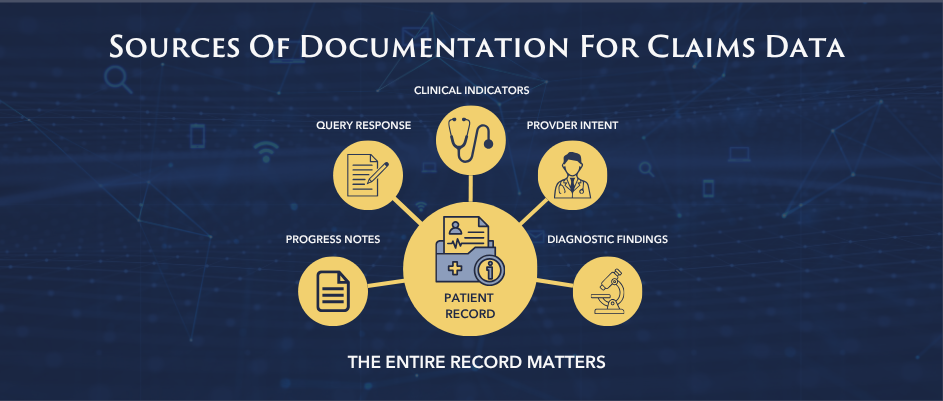
Payers often cite “the diagnosis only appeared on the query,” or the lack of consistent use of the coding term throughout the health record, or the absence of the diagnosis (in ICD-10 language) in the discharge summary as reasons to remove a clinically significant diagnosis that meets reporting requirements from the claim. Often, queries are issued to obtain an impactful diagnosis (e.g., one that adds a CC or MCC to the claim) that is clinically valid and reportable for inclusion in the discharge summary. This is a huge waste of limited resources and is annoying to most providers. The reference to diagnoses being in the discharge summary is from old coding guidance that advised that the principal diagnosis be listed and that all secondary diagnoses appear in the final diagnosis list or be reflected in the final diagnostic statement. However, since that time, coding guidance explicitly states that coders must review the entire record for diagnoses (not just the discharge summary).
The draft brief specifically states, “If a compliant query has been properly answered and authenticated by a responsible provider and is part of the permanent health record, it is sufficient for code assignment. The response to the query is not required to be repeated elsewhere in the health record.” When querying was first introduced, the preferred query format was open-ended, and the response had to be documented in a subsequent medical record note because there was no other way to include it in the permanent health record. In fact, CDIs used to spend a lot of time following up with providers to remind them to document their query response within the health record.
Open-ended queries were difficult for both the provider and the query professional. The provider did not know coding terminology, so the query response often failed to yield the desired result of clarifying existing documentation into terms that translate into diagnosis codes. The shift to multiple-choice queries began while health records were paper, but became the preferred query format during the transition to EMRs because it added efficiency to the query process for both query professionals and the provider being queried. Additionally, multiple-choice queries provide the provider with coding terms that appear to align with the clinical scenario, thereby increasing their efficacy.
One of the most important inclusions in the draft is the statement that “There is no specific direction as to where a diagnosis must be documented or how often the diagnosis must be documented to allow it to be reported.” Although the query practice brief, once finalized, is only industry guidance, this is an important statement to include in appeals when a diagnosis is challenged because it is documented using ICD-10-CM terminology only once.
Appealing payer denials can be a cumbersome task that requires more than coding or clinical knowledge. In today’s healthcare environment, where profits are limited for both payers and hospitals, those appealing payer denials need to be experts in healthcare regulations, coding, and medicine.
As query expectations change, healthcare organizations need practices that are both compliant and trustworthy, supporting accurate documentation and provider confidence.
Turn Practice Brief Guidance into Action
The 2026 Practice Brief Draft provides valuable guidance, but implementation is where results are achieved. Whether you’re evaluating AI-assisted queries, strengthening compliance processes, or responding to payer challenges, Brundage Group can help. Our physician-led experts provide the guidance, education, and support needed to build a compliant, defensible, and effective query program.