Part 1 of a 3 Part Series
The draft of the 2026 ACDIS/AHIMA Practice Brief, “Guidelines for Achieving a Compliant Query Practice,” reflects a sophisticated understanding of the modern documentation environment. The authors wisely include the ambulatory and professional fee environments, recognizing that the impact of documentation integrity is no longer confined to the hospital setting and MS-DRG methodology. This draft serves as a powerful reminder that while industry tools are changing, the core mission remains the same: ensuring the health record accurately reflects the patient’s clinical story.
This update is timely with the U.S. Department of Health and Human Services (HHS) and the Office of Inspector General (OIG) signaling increased scrutiny of AI (artificial intelligence) use in healthcare. As we move deeper into an era that feels like an AI arms race, this draft provides impressive thoroughness. It takes a proactive stance regarding the evolving role of technology and the integrity of clinical documentation. By moving beyond high-level mentions to provide a structured compliance framework for technology-generated queries, ACDIS and AHIMA have provided the industry with a much-needed roadmap. The workgroup deserves significant praise for tackling these complex, “front-line” issues with clarity and foresight.
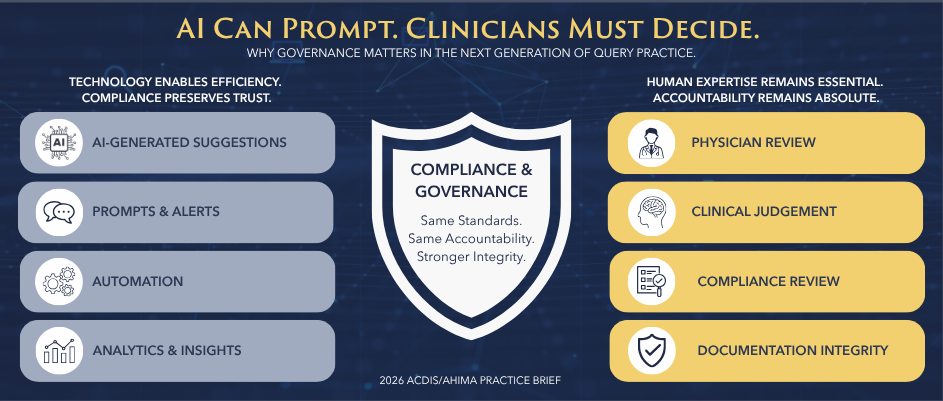
The draft’s additions on AI governance are essential, as hospitals must balance point-of-care documentation efficiency with billing compliance. Specifically, the brief recognizes that technology is being “increasingly integrated” into electronic health records and expands the definition of querying to include “prompts, nudges, advisories, alerts, or similar terms” for technology-generated documentation clarification opportunities. The brief also attempts to close the query terminology loophole by declaring that “a communication constitutes a query when it presents a provider with a specific diagnosis or documentation option for consideration in connection with a specific patient encounter.” As with prior briefs, this one argues that regardless of what terms are used to describe a documentation clarification tools or when clarification is requested during the encounter, “technology-generated queries are subject to the same compliance standards as manually constructed queries.”
Stay Tuned for Part 2
In this article, we looked at how the 2026 Practice Brief Draft addresses technology-generated queries and applies the same compliance standards to AI-assisted documentation tools as to traditional queries. Next week, we’ll focus on another important part of the draft: “Refining a Compliant Query Practice.” We’ll share practical tips for healthcare organizations to improve their query processes, engage providers, and maintain accurate documentation as technology continues to evolve.
Get in touch with Brundage Group’s expert team to improve your query practice.
We can review your documentation, ensure it meets industry standards, and help you use AI to improve compliance and accuracy.