Part 2 of a 3 Part Series
In Part 1, we explored how the draft 2026 ACDIS/AHIMA Practice Brief addresses technology-generated queries and affirms that AI-assisted documentation tools must meet the same compliance standards as traditional queries. In Part 2, we cover another key update: the Practice Brief’s effort to redefine compliant query practice and clarify how the guidance should, and should not, be used in payer reviews and claim disputes.
An unintended use of prior query practice briefs was their use as a payer denial tool. Query experts Cheryl Ericson, Senior Director of Clinical Policy and Education, and Robin Sewell, Lead Clinical Coding Analyst at Brundage Group, presented at last year’s National ACDIS conference on this topic. The updated 2026 ACDIS/AHIMA Practice Brief, “Guidelines for Achieving a Compliant Query Practice,” addresses this topic head-on by discussing the draft’s intent and limitations.
First, it is important to acknowledge the elephant in the room. Even though physicians are independently reimbursed for the services they provide, their documentation serves not only as the basis for their professional reimbursement but also impacts hospital finances. Clinical documentation impacts hospital reimbursement through a variety of mechanisms, ranging from determining patient status to MS-DRG assignments to performance on quality-of-care measures. Because clinical concepts often lack alignment with clinical code sets, queries are a necessary “communication tool” used to “ensure documentation integrity and the accuracy of diagnosis, procedure, or service code assignment for an individual encounter in any healthcare setting.” Queries “support accurate, complete, and clinically valid documentation” so the provider’s intent can be reflected within administrative (claims) data.
The basis of ethical and compliant querying is identifying clinical misalignment with coding concepts that can result in an inaccurate representation of the patient when their encounter must be explained and justified using diagnosis and procedure codes. As payers look to cut expenditures, some have found success by removing diagnoses from claims when they determine a query is “noncompliant.” Their reasoning appears to be that the diagnosis obtained from a query the payer considers noncompliant is the fruit of the poisonous tree and, therefore, must be excluded.
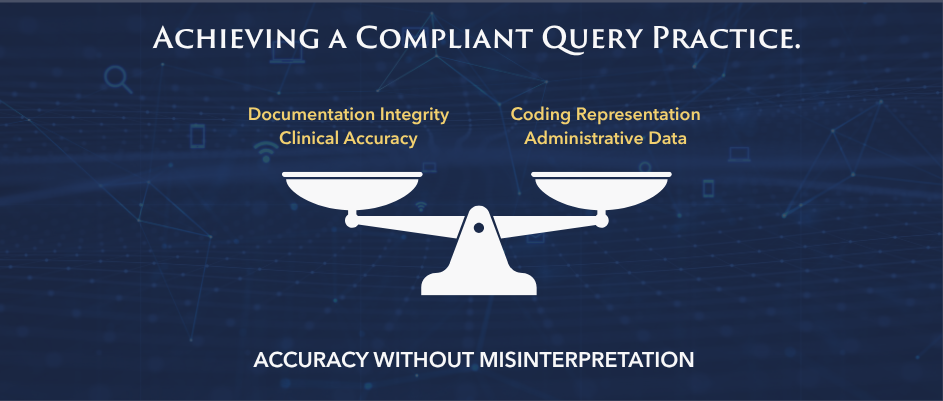
The authors of this updated brief address this payer trend by clearly stating that the brief, “is not intended for use as a basis for denying claims or disputing clinical queries.” Furthermore, it states that use of the brief “as a stand-alone rationale for claim denials, post-payment recovery, or adverse audit findings is inconsistent with its purpose and scope.” It is sufficient for query professionals to demonstrate “substantial compliance,” meaning the query meets general query requirements even if it may include an “isolated technical deviation, such as a minor formatting inconsistency, a missing source date on a single indicator, or a query title visitable to the provider that is descriptive but not diagnosis-directing.” In other words, the brief was never intended to serve as a payer-denial manual.
Stay Tuned for Part 3
The 2026 Practice Brief Draft reinforces an important principle: compliant query practice is designed to support documentation integrity and accurate representation of the patient story, not serve as a standalone basis for claim denials. By clarifying the concept of substantial compliance and reaffirming the intended purpose of queries, the draft provides meaningful guidance for organizations navigating increased payer scrutiny.
Next week, we’ll explore “Sources of Documentation and Claims Data,” examining how the Practice Brief addresses the clinical evidence, documentation sources, and administrative data that support compliant query practices and accurate code assignment.
Need Support to Strengthening your Query Program?
Let our physician-led experts help your team build a sustainable, compliant query program that meets industry standards and withstands external scrutiny.