
Sharp Debridement, Excisional Queries, and Depth Documentation
By Robin Sewell, CDIP, CCS, CIC, CPC, CCDS
In our last Query IQ article, we borrowed a line from The Princess Bride, when the character finally tells Inigo Montoya, “Stop saying that!” after hearing the same phrase repeatedly.
Apparently, we are continuing the Princess Bride theme this month.
There is another famous line in the movie when Inigo tells Vizzini regarding his constant use of the term “Inconceivable!”
“You keep using that word. I do not think it means what you think it means.”
That’s often how CDI specialists and coders feel when a provider documents “sharp debridement.”
In the world of CDI and coding, “sharp” debridement does not necessarily mean that an “excisional” debridement was performed.
Excisional Debridement
Inpatient coding guidance has long been clear that describing a debridement as “sharp” or documenting the use of scissors, curettes, or other sharp instruments does not automatically qualify the procedure as “excisional” debridement. The documentation must include an “excisional” tissue removal to code the root accurately as “excision.” In the absence of such documentation, the procedure, if coded, is at high risk of denial and DRG downgrade.
Over the years, CDI specialists and coders have become very good at querying providers to clarify the distinction between excisional and non-excisional debridement.
Identifying the Body Part and Layers Debrided
However, even when the “excisional” question is resolved, another documentation detail can still create problems: The deepest anatomic layer debrided.
To be fair, documenting the depth of debridement has always been considered best practice. Under ICD-9-CM, however, coders often arrived at the appropriate procedure code through the Alphabetic Index and its sub-terms, where the available codes did not always require the same level of anatomic specificity.
ICD-10-PCS changed that. The coding construct requires coders to select the specific body system and body part directly from the PCS tables, making documentation of the deepest anatomic layer involved critical for accurate code assignment.
The Payer Denial
And this is exactly where a recent denial we reviewed came into play.
In this case, the provider documented that the wound was debrided “down to healthy tissue.” Well, that doesn’t translate to ICD-10-PCS coding. Therefore, a query for anatomic depth was submitted and answered as “down to fascia”. The payer denied the PCS code, reasoning that since the documentation did not explicitly state that the fascia itself was debrided, the procedure should not be coded at that level, and the DRG should be downgraded.
Not so fast…
In ICD-10-PCS, subcutaneous tissue and fascia are grouped under the same body system in the table below. Because these structures share the same body system construct, documentation supporting debridement to either level leads the coder to the same PCS table and body system, meaning the code assignment would not change even if debridement included only subcutaneous tissue.
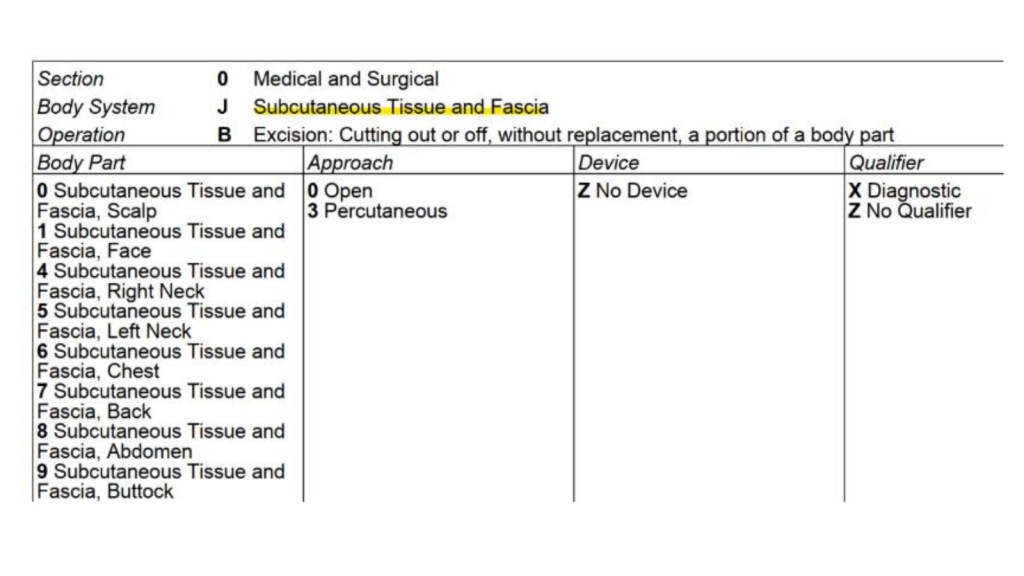
The coding is further supported by PCS guideline A10, which states: “And” when used in a code description, means “and/or” except when used to describe a combination of multiple body parts for which values exist for each body part.
Additionally, the phrase “down to” generally implies that the preceding tissue layers were debrided to reach that level. For example, to expose or reach the fascia, subcutaneous tissue would also be debrided, rendering the payer’s rationale for the denied questionable from both clinical and coding perspectives.
While this particular denial may have been a stretch, it highlights an important opportunity for documentation.
Querying for Debridement Procedures in ICD-10-PCS
When querying providers regarding debridement procedures, it is helpful and compliant to include answer options that clearly identify the deepest anatomic layer debrided, such as:
- Skin
- Subcutaneous tissue
- Fascia
- Muscle
- Bone
Using phrasing such as “down to and including” the specified anatomic layer can eliminate ambiguity and better align the documentation with the ICD-10-PCS coding structure. And of course, don’t forget the other words that still matter: “Excisional.”
This same principle applies to procedures such as incision and drainage, where the deepest anatomic layer, i.e., the most specific body part, may be distinguished from an anatomic region, thus supplying the most specific code from the PCS coding table.
Yes, providers may dislike these queries—and frankly, we don’t love sending them either. But when the coding system requires this level of specificity, CDI specialists and coders are simply translating the clinical documentation into the language required by ICD-10-PCS.
So, the next time a procedure note reads “sharp debridement” and/or “down to” a particular layer, remember the immortal wisdom of The Princess Bride: “You keep using that word. I do not think it means what you think it means.”
Ready to Optimize Debridement Documentation?
Learn how documentation gap and ICD-10-PCS rules impact coding accuracy, denials, and DRG Integrity