Hospitals don’t have a data problem. They have a connection problem.
Most health systems already generate the data needed to catch missed revenue; it’s sitting in the EMR, in census reports, in UR queues. The problem is that it’s disconnected: a status change here, a denial trend there, a physician advisor working from a spreadsheet three steps behind. By the time anyone sees the full picture, the revenue opportunity has already passed.
That’s the gap the Certus Suite was built to close.
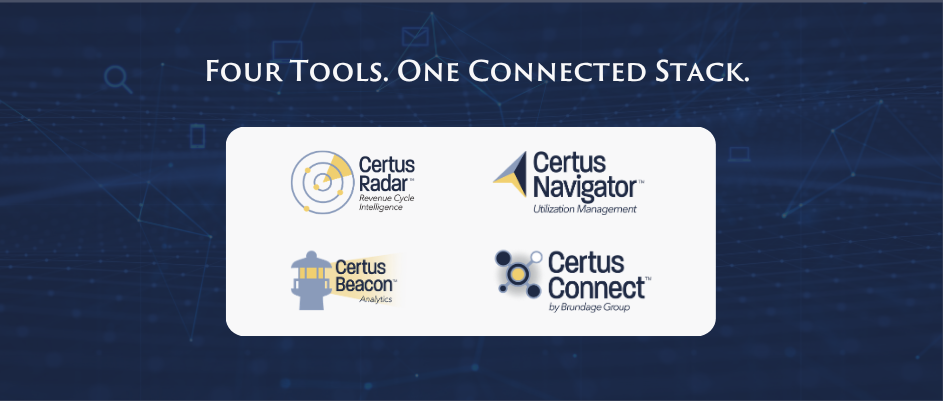
Four Tools. One Connected Stack.
Rather than layering another standalone dashboard onto an already fragmented workflow, Brundage Group built four tools designed to work as a single, continuous system—connected to your EMR and to each other, with no manual work in between.


Four tools, one narrative: connect the data, find the opportunity, understand it, and act on it automatically, without adding to your team’s day.
Why It’s “Tech-Enabled” and “Clinically-Driven”
Technology alone doesn’t fix a revenue cycle; a dashboard is only as good as the judgment behind it. That’s why every layer of the Certus Suite is built alongside Physician Advisors and revenue cycle experts who know what “the right case, right status, right result” looks like in practice. Technology finds and routes the opportunity; clinical expertise makes sure it’s captured correctly, compliantly, without adding friction to your care teams.
What Clients Are Seeing
The results speak for themselves:
These aren’t projections; they’re outcomes from hospitals running the same connected stack, with the same clinical oversight, at scale.
If you’re missing revenue you’ve already earned, for care you’ve already delivered, the fix usually isn’t more staff or more manual review. It’s a stack that connects, finds, understands, and acts before the opportunity closes.
Ready to See What You’re Missing?
Reach out to our team to see how Certus Connect, Certus Beacon, Certus Radar, and Certus Navigator will work together for your organization.